
Qigong & Tai Chi
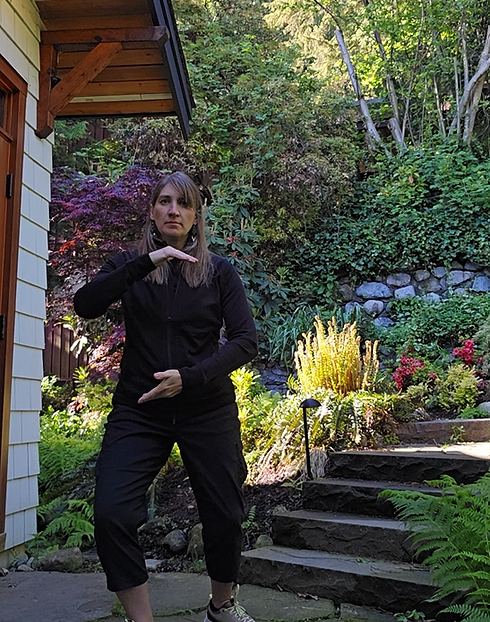
What is Qigong?
"Qi" (pronounced like "chee") means energy, and "gong" means "to work", "to practice", or "to cultivate".
Qigong is simply working with your body's own energy, or "energy work" and is one of the best ways to maintain a healthy lifestyle. Anyone, regardless of ability, age, or beliefs can practice qigong.
When your qi (energy) becomes blocked or is stagnant, it can manifest as physically symptoms. When the blockages are removed, your body's qi flows with ease and you get better faster-it's that simple.
Looking at the etymology of of qi, the character below depicts steam rising from a bowl of rice. You can think of qi this way. It cannot be seen, but felt and it has action.
氣
Qigong is an ancient Chinese practice that has been cultivated for thousands of years and is one of the therapeutic pillars of Traditional Chinese Medicine. It focuses on cultivating and harmonizing qi, or vital energy, to support health, balance, and well-being. Over time, qigong has evolved into several distinct traditions, each with its own emphasis. Medical Qigong focuses on healing, prevention, and restoring balance within the body. Martial Qigong develops strength, stability, resilience, and internal power for martial arts practice. Spiritual Qigong cultivates meditation, self-awareness, and a deeper connection to oneself and the natural world. While each tradition has a unique purpose, they all share the common goal of improving the flow of energy to support a healthier, more aligned life.
My qigong training has been with Master Chunyi Lin, Munira Jiwa (both of Spring Forest Qigong), and Mimi Kuo-Dimmer.

Qigong Movement & Meditation
Qigong is a practice of breathing, focusing your mind, doing very simple body movements, all with intention. I think of it as a moving meditation. The movements are done within your body's range. It's simple and gentle, yet very powerful. You can practice standing or seated, or even laying down!
One's intention is a very important part of qigong practice. We call the intention, yi. Your yi moves your qi.
You can practice anywhere or anytime, no equipment is needed. Joining a practice group is a powerful way to experience qigong. Being in community, allows for an increase of energy felt by the practitioner. All are welcome - no previous experience is necessary. See current class schedule here.
It has been life changing for me. Thousands of people worldwide have reported incredible results in their physical and emotional well-being.


Qigong Healing
Another way to experience Qigong is with a Qigong healing session. These sessions involve directing and balancing your qi to promote healing and well-being. It is done to clear energy blockages and restore the natural flow of qi in the body. This practice works in harmony with your body’s innate ability to heal itself, empowering your natural processes to address physical, emotional, and energetic imbalances. Clients often leave feeling rejuvenated, relaxed, and aligned, with a renewed sense of vitality. Email me to learn more.
Benefits of Qigong
-
Increases oxygen uptake for stronger muscles
-
Soothes your nervous system
-
Improves your metabolism & digestion
-
Aides in weight control, a youthful appearance & balanced energy
-
Gives your organs an "internal massage" to retard the aging process by restoring them to healthy, optional functioning
-
Clears your mind for greatly mental clarity
-
Lubricates your joints for pain-free movement & greater flexibility
What my students report the benefits are:
-
Deal with stress and tension in on a daily basis
-
Such a great feeling with circle of friends
-
Qigong helps with feeling of being overwhelmed by life. Calm and peace.
-
A better awarness of my body health and stress
-
Feel less stress after classes
-
Overall happier demeanor and peace
-
Mental clarity and focus
What is Tai Chi
Tai chi (or less commonly t'ai chi or tai chi chuan or t'ai chi ch'uan; original Mandarin Chinese pronunciation (Tàijí), it is pronounced "tye-jee") is a slow, graceful exercise that promotes calm mental focus and alignment while building leg strength, endurance and stability. Ideal for increasing stamina, flexibility and coordination. Tai chi is a form of qigong, an ancient form of non-impact marital arts that was developed in China over 700 years ago.
Tai chi can be translated to “supreme ultimate” and depicted as the yin yang symbol. Tai chi focuses on this mind-body connection to open up the flow of qi (vital energy) throughout the body. It has many references to nature in its philosophies and naming of the movements.
You can apply it to everything you do, including how you interact with others.
Benefits of Tai Chi
There is a large body of research that suggest that tai chi practice is beneficial for:
-
Balance and fall prevention
-
Bone mineral density
-
Cancer quality of life
-
Cardiovascular and respiratory disease
-
Chronic fatigue, fibromyalgia, and other autoimmune conditions
-
Chronic lower back pain other pain management
-
Cognitive function
-
Orthopedic and neurological issues
-
Stroke and stroke risk factors
-
Parkinson’s, MS and other chronic conditions
-
Sleep disorders

If you’re a beginner seeking a simplified approach to learning Tai Chi, the Tai Chi Fundamentals (TCF) Program or the Tai Chi Fundamentals Adapted (TCFA) Program, is where I recommend you start. See my current class schedule here.
The TCFA Program is designed to make tai chi accessible to people of all ages and abilities and features three versions: Optional Side Support with a chair next to you for balance when needed, Walker Support, and Seated.
Tai Chi History, My Teachers & Lineage
Tai chi was created by Chang San Feng in the 13th century AD after watching a bird and snake battle. It was traditionally passed down from father to son and practiced in secret in China’s northern Chen Village. Master Yang Lu Shan was the first to learn tai chi as a non-family member. In the mid-1800’s he was a commander of the imperial guard and he taught tai chi to his men for self-defense. Master Yang Cheng Fu, Yang Lu Shan’s grandson, modified his family form in the early 20th century.
As the years went on it became a widely practiced form of martial arts and with that came many adaptations. There are three main styles that are still practiced today which are each named after their creator: Yang style, Chen style, and Wu style. One adaptation that became very popular was created in the 1930s by one of Yang Chen Fu’s students, Cheng Man Ch’ing. He shortened the Yang form to make it more accessible to practice for other reasons than just for martial arts; there was a focus on tai chi for health.
Grand Master Chen Man Ch’ing ended up coming to the United States in the 1960’s and brought tai chi with him. He was the first to teach tai chi to non-Chinese students.

Tai Chi Fundamentals Program
The Tai Chi Fundamentals program is part of the Yang lineage. It was created by Tricia Yu. While living in Taiwan in the late 1960’s and early 70’s, Tricia started to learn tai chi from Master Liu Pei Ch’ung and was his only non-Chinese student. When back in the States, Tricia continued to study under Grandmasters Benjamin Pan Jeng Lo and William C.C. Chen, two of Chen Man Ch’ings students, by whom she became certified to teach the Yang style form. Tricia saw a need to make the form more accessible for people to learn and created the Tai Chi Fundamentals Program.
Tricia Yu developed the Original Tai Chi Fundamentals® Program (TCF) in 1996, as a simplified prequel to the Yang Style Cheng Man Ch’ing Lineage form, and the Tai Chi Fundamentals® Adapted Program (TCFA), which includes Optional Side Support, Walker Support and Seated versions. Both can be gateway programs for progressing to the Yang Style Cheng Man Ch’ing Lineage form.
I have been under the study of and certified in TCF, TCFA, and Tai Chi Prime by Pat Culotti (who has been formally certified by Michael Milewski from the T’ai Chi Ch'uan Center of Milwaukee, Master Benjamin Lo of San Francisco, and Master William C. C. Chen of New York), as well as Rachel Sandretto (trained by Tricia Yu and Pat Culotti).
To learn more about Tai Chi Fundamental Programs visit the Tai Chi Health website.